miércoles, 24 de septiembre de 2025

MUSIC - 20th-Century Classical Music 7 / 7 - Aaron Copland 1900 – 1990

 MUSIC 


            20th-Century Classical Music 7 / 7 
                      Aaron Copland 
                          1900 – 1990                     

If we are interested in listening to an uplifting masterpiece of the middle of the XX Century, we must remember the marvelous composition of Aaron Copland named "Fanfare for the Common Man". A remarkable music work containing spiritual elevation, a tribute to bravery, giving any human listener a melodic and rhythmic combination which leads us to an inner feeling of enthusiasm  and perseverance.

A wonderful way to round up this brief selection of Masters of the XX Century as Copland approaches his citizens with this hymn to humankind living in hard moments, when we are required to overcome tragedies, impoverishment or even social conflicts, as in modern days. It is undoubtedly a masterpiece full of hope for humankind.

We surely desire you to enjoy it as much as we are deeply motivated to share it with you.

ALMO


Wikipedia, The Free Encyclopedia

Aaron Copland (/ˈkplənd/ KOHP-lənd; November 14, 1900 – December 2, 1990) was an American composer, critic, writer, teacher, pianist, and conductor of his own and other American music. Copland was referred to by his peers and critics as the "Dean of American Composers". The open, slowly changing harmonies in much of his music are typical of what many consider the sound of American music, evoking the vast American landscape and pioneer spirit. He is best known for the works he wrote in the 1930s and 1940s in a deliberately accessible style often referred to as "populist" and which he called his "vernacular" style. Works in this vein include the ballets Appalachian SpringBilly the Kid and Rodeo, his Fanfare for the Common Man and Third Symphony. In addition to his ballets and orchestral works, he produced music in many other genres, including chamber music, vocal works, opera, and film scores.

After some initial studies with composer Rubin Goldmark, Copland traveled to Paris, where he first studied with Isidor Philipp and Paul Vidal, then with noted pedagogue Nadia Boulanger. He studied three years with Boulanger, whose eclectic approach to music inspired his own broad taste. Determined upon his return to the U.S. to make his way as a full-time composer, Copland gave lecture-recitals, wrote works on commission and did some teaching and writing. But he found that composing orchestral music in a modernist style, which he had adopted while studying abroad, was unprofitable, particularly in light of the Great Depression. He shifted in the mid-1930s to a more accessible musical style that mirrored the German idea of Gebrauchsmusik ("music for use"), music that could serve utilitarian and artistic purposes. During the Depression years, he traveled extensively to Europe, Africa, and Mexico, formed an important friendship with Mexican composer Carlos Chávez, and began composing his signature works.

During the late 1940s, Copland became aware that Stravinsky and other fellow composers had begun to study Arnold Schoenberg's use of twelve-tone (serial) techniques. After he had been exposed to the works of French composer Pierre Boulez, he incorporated serial techniques into his Piano Quartet (1950), Piano Fantasy (1957), Connotations for orchestra (1961), and Inscape for orchestra (1967). Unlike Schoenberg, Copland used his tone rows in much the same fashion as his tonal material—as sources for melodies and harmonies, rather than as complete statements in their own right, except for crucial events from a structural point of view. From the 1960s onward, Copland's activities turned more from composing to conducting. He became a frequent guest conductor of orchestras in the U.S. and the UK and made a series of recordings of his music, primarily for Columbia Records.

Fanfare for the Common Man is a musical work by the American composer Aaron Copland. It was written in 1942 for the Cincinnati Symphony Orchestra under conductor Eugene Goossens and was inspired in part by a speech made earlier that year by then American Vice President Henry A. Wallace, in which Wallace proclaimed the dawning of the "Century of the Common Man".

Several alternative versions have been made and fragments of the work have appeared in many subsequent US and British cultural productions, such as in the musical scores of movies.


Aaron Copland - Fanfare For The Common Man

martes, 23 de septiembre de 2025

POETRY - The September Gift - 2025


POETRY

                               
                       The September Gift
                                   2025


Truth has arrived forever,

all who are awake are filled with grace,

time and space have embraced each other,

now there is nothing to fear,

as we breathe and enjoy Unity,

Beauty prevails and shines within us,

above all, Peace bows before you.


ALMO


Eva Cassidy - Over The Rainbow

lunes, 22 de septiembre de 2025

MUSIC - 20th-Century Classical Music 6 / 7 - Dmitri Shostakovich 1906- 1975

 MUSIC 


                 20th-Century Classical Music 6 / 7 
                      Dmitri Shostakovich 
                            1906- 1975 

A talented composer of his time, Dimitri Shostakovich had quite difficult moments during all his life that inspired him towards several wonderful masterpieces, all of which show us how music can reveal all the ups and downs in the modern times. Whenever you want to discover some unique beautiful music of the XX century, you will find his works present in the top ranked musicians who have followed the development of a unique composer. 

We can understand the pressure he must have felt during all his life, but at the same time, one may also feel those hard days as the promoters of some new approaches towards compositions which enable us to try to understand how and why he could survive under strict regulations that helped him to create marvelous works that are now cherished by orchestras and soloists on today's scenarios.


Wikipedia, The Free Encyclopedia

 Dmitri Dmitriyevich Shostakovich (25 September [O.S. 12 September] 1906 – 9 August 1975) was a Soviet-era Russian composer and pianist who became internationally known after the premiere of his First Symphony in 1926 and thereafter was regarded as a major composer.

Shostakovich achieved early fame in the Soviet Union, but had a complex relationship with its government. His 1934 opera Lady Macbeth of Mtsensk was initially a success but later condemned by the Soviet government, putting his career at risk. In 1948, his work was denounced under the Zhdanov Doctrine, with professional consequences lasting several years. Even after his censure was rescinded in 1956, performances of his music were occasionally subject to state interventions, as with his Thirteenth Symphony (1962). Nevertheless, Shostakovich was a member of the Supreme Soviet of the RSFSR (1947) and the Supreme Soviet of the Soviet Union (from 1962 until his death), as well as chairman of the RSFSR Union of Composers (1960–1968). Over the course of his career, he earned several important awards, including the Order of Lenin, from the Soviet government.

Shostakovich combined a variety of musical techniques in his works. His music is characterized by sharp contrasts, elements of the grotesque, and ambivalent tonality; he was also heavily influenced by neoclassicism and by the music of Gustav Mahler. His orchestral works include 15 symphonies and six concerti (two each for piano, violin, and cello). His chamber works include 15 string quartets, a piano quintet, and two piano trios. His solo piano works include two sonatas, an early set of 24 preludes, and a later set of 24 preludes and fugues. Stage works include three completed operas and three ballets. Shostakovich also wrote several song cycles and a substantial quantity of music for theatre and film.


ALMO


Yuja Wang: Shostakovich Piano Concerto No. 2 in F major, Op. 102(Carnegie Hall, 2021)

POESIA - página lirica - Invitación a la Paz


POESIA


                                   página  lirica

                       
                       Invitación a la Paz

¡ Hombres, mujeres y niños
de toda la tierra :
vamos pronto a hacerle
la guerra a la guerra !

¡ Vamos a tomarnos 
todos de las manos
y a danzar alegres
cual buenos hermanos.

¡ Vamos a mirarnos
con miradas mansas ;
a hablarnos sin odio,
con tiernas palabras !

¡ Vamos a lanzarnos
todos a los campos,
a labrar la tierra,
no a librar batallas !

¡ Formemos legiones
de gentes amigas :
que en vez de fusiles
florezcan espigas !

¡ Europa, Asia, África,
Oceanía y América :
deponed la histérica
fiebre de matanza !

¡ No más bayonetas
ni ametralladoras,
cañones ni tanques,
cohetes ni bombas !

¡ No más exterminios,
no más destrucciones :
que en vez de estampidos
resuenen canciones !

¡ No más terrorismo,
miseria y dolor :
que el mundo sea todo 
sembrado de amor !

¡ Que la tierra entera
sea un campo feraz,
donde el hombre viva
dichoso y en paz !


Luis Eladio Guevera


Fuente: Órgano de Cultura y Difusión del Centro de Orientación Filosófica. Mayo, 1974. Caracas, Venezuela. Derechos reservados.

sábado, 20 de septiembre de 2025

POESIA / POETRY - Día Internacional de la Paz - 2025 - International Day of Peace


POESIA 

               Día Internacional de la Paz
                             2025


Es como poder respirar sin desalientos,
amar la vida en todos los aspectos,
traspasar las emociones sin tantos titubeos,
y así alcanzar la cima de tu felicidad.

Resulta fácil si sueltas los apegos,
parece una fábula o una quimera,
sin buscar excusas o falsas promesas,
es el mayor premio sin buscarlo por fuera.

Perder el tiempo es creer en la fuerza,
soltar las anclas de la sub-humana naturaleza,
deja fluir tu Ser, es tu mayor nobleza,
al sentirte sólo y quieto. vives la Paz Eterna.

----------------------------------------------------------------------

               International Day of Peace
                             2025


It's like being able to breathe without discouragement,
loving life in all its aspects,
transcending emotions without hesitation,
and thus reaching the peak of your happiness.


It's easy if you let go of attachments,
it seems like a fable or a pipe dream,
without looking for excuses or false promises,
it's the greatest reward without seeking it outside yourself.


To waste time is to believe in force,
to let go of the anchors of subhuman nature,
let your Being flow, it is your greatest nobility,
when you feel alone and still, you live Eternal Peace.


ALMO


Barbra Streisand - One God


MUSIC - 20th-Century Classical Music 5 / 7 - Igor Stravinsky 1882- 1971

 MUSIC 


                 20th-Century Classical Music 5 / 7 
                          Igor Stravinsky
                                   1882- 1971  
 
A special referential musicians in the XX century is Igor Stravinsksy, an icon of the folk influence in classical compositions. The fluency of rhythm along with inspirational tones to raise the basics to highest standards of music reveals how a composer can become an excellent interpreter of his time and the process of experimenting music in different levels of understanding life.

You may enjoy our selection of one of his masterpieces as we encourage you to continue to follow his steps with other compositions.


Wikipedia, The Free Encyclopedia

Igor Fyodorovich Stravinsky (17 June [O.S. 5 June] 1882 – 6 April 1971) was a Russian composer and conductor with French citizenship (from 1934) and American citizenship (from 1945). He is widely considered one of the most important and influential composers of the 20th century and a pivotal figure in modernist music.

Born to a musical family in Saint Petersburg, Russia, Stravinsky grew up taking piano and music theory lessons. While studying law at the University of Saint Petersburg, he met Nikolai Rimsky-Korsakov and studied music under him until the latter's death in 1908. Stravinsky met the impresario Sergei Diaghilev soon after, who commissioned the composer to write three ballets for the Ballets Russes's Paris seasons: The Firebird (1910), Petrushka (1911), and The Rite of Spring (1913), the last of which caused a near-riot at the premiere due to its avant-garde nature and later changed the way composers understood rhythmic structure.

Stravinsky's compositional career is often divided into three main periods: his Russian period (1913–1920), his neoclassical period (1920–1951), and his serial period (1954–1968). During his Russian period, Stravinsky was heavily influenced by Russian styles and folklore. Works such as Renard (1916) and Les noces (1923) drew upon Russian folk poetry, while compositions like L'Histoire du soldat (1918) integrated these folk elements with popular musical forms, including the tangowaltzragtime, and chorale. His neoclassical period exhibited themes and techniques from the classical period, like the use of the sonata form in his Octet (1923) and use of Greek mythological themes in works including Apollon musagète (1927), Oedipus rex (1927), and Persephone (1935). In his serial period, Stravinsky turned towards compositional techniques from the Second Viennese School like Arnold Schoenberg's twelve-tone techniqueIn Memoriam Dylan Thomas (1954) was the first of his compositions to be fully based on the technique, and Canticum Sacrum (1956) was his first to be based on a tone row. Stravinsky's last major work was the Requiem Canticles (1966), which was performed at his funeral.

While many supporters were confused by Stravinsky's constant stylistic changes, later writers recognized his versatile language as important in the development of modernist music. Stravinsky's revolutionary ideas influenced composers as diverse as Aaron CoplandPhilip GlassBéla Bartók, and Pierre Boulez, who were all challenged to innovate music in areas beyond tonality, especially rhythm and musical form. In 1998, Time magazine listed Stravinsky as one of the 100 most influential people of the century. Stravinsky died of pulmonary edema on 6 April 1971 in New York City, having left six memoirs written with his friend and assistant Robert Craft, as well as an earlier autobiography and a series of lectures.


ALMO

almoxxi.blogspot.com

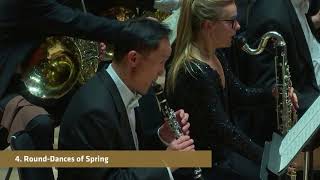
Stravinsky The Rite of Spring // London Symphony Orchestra/Sir Simon Rattle

MUSICA - Sabor a Navidad en Venezuela 2 / 12

  MUSICA                    Sabor a Navidad en Venezuela                                      2 / 12 Compartir la Navidad en Venezuela es si...